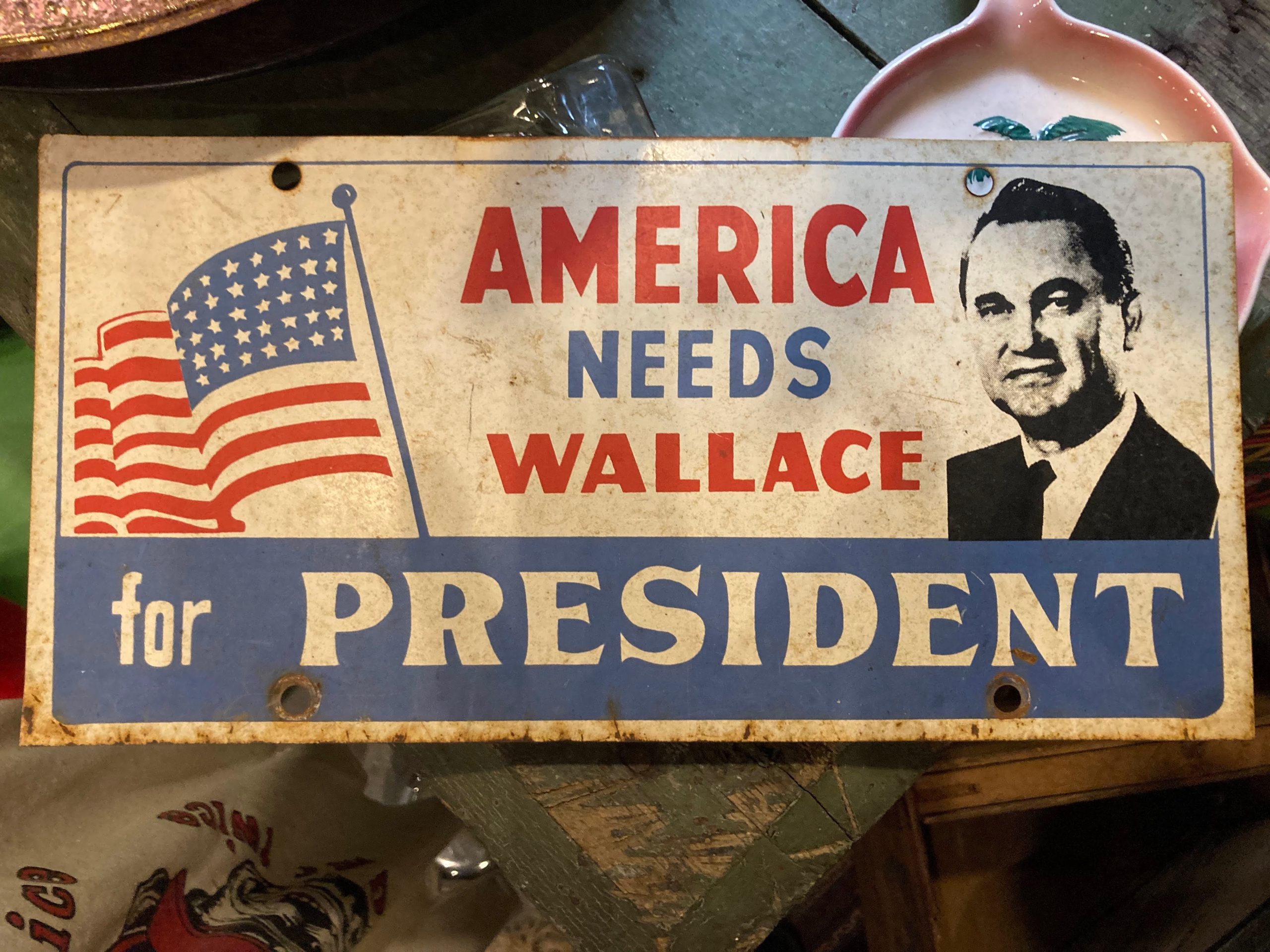
One thing about the 60s and marijuana was the MUNCHIES! Oh, yeah, chocolate chip cookies were the cure! One night a friend Tom, a Ph.D. candidate in history at the University of Miami, and I walked to the mini mart at Bird Road and 27th Avenue. I know it was 1968 because on the way back he told me he had decided who to vote for as president. I was a year short to vote back then.
“Who?” I asked.
“George Wallace!” he answered.
I went ballistic, ranted and raved that he would even possibly think that.
“Calm down Phil, you haven’t asked me why yet!”
“Why?”
“If Wallace is selected I’ll no longer hesitate to leave for Canada to escape the draft!”
At the mini mart was a little brown mongrel, no collar or ID, begging. We gave her a chocolate chip cookie and that was it! She followed us back to my apartment. It was well into the night. What to do about her? I thought in the morning I would take her to a shelter. So I put her in a jeep for a few hours. Got up, still there. Went and got some dry food. That was it. I had a dog. She had such a delicate sweet face that Lady fit her.
Bob Daily was the physical anthropology professor at Florida State University. He proved to be incredibly important to me my last year when I was doing an original ethnography of a southern farming community for an Honors Bachelors degree. That involved original research, a dissertation and a defense before a committee.
He loved animals. At the beginning of every class he came over to pet Lady, but one day she was not there.
You see, in Mike Launers Russian class (I had a degree in both anthropology and Russian, a long story I’ll get to it eventually) Lady did one of those scrunching up groans a dog does. The class cracked up laughing. Mike,
“Phil, please don’t bring Lady to class.”
OK.
The next physical anthropology class arrives. When we arrived Dr. Daily would be filling the blackboard with closely written facts for that day’s lecture. Then he would go to his lectern, look down through his glasses shuffling his lecture notes, and then come over to pet Lady. Every class!
That day he goes to pet Lady. No Lady. He pulled up the legs of his slacks so he could squat down and look under the tables. Our class was in the physical anthropology lab, long tables painted black with shiny lacquer finishes. We sat at these in rows. I could hear all the women bringing their legs together for modesty as Bob looked under the tables. He went back to his lectern and looking down at his notes he said,
“Mr. Spitzer!”
Of course I jumped. He was so formal he was scary! He never used our first names. I was the first FSU undergraduate who went on to do a doctorate in anthropology. Towards the end of my time he asked if he could call me “Phillip”. Boy, could he. So, I answered,
“She’s at home”
Without looking up from his papers he said,
“Oh, I didn’t know she let you out alone!”
More laughter!
The story of Tom voting for Wallace was actually preceded, when I wrote much of this 40 years ago, by a discussion of my political analysis and philosophy during our years as protesting activists in the Sixties. Of course we were all against the war then. It was not until I had gone through my several months back home from college and my time with the Interior department (Winter 1967 through Winter 1969) and I had become an environmental activist that I got serious to thinking and acting on all this. What came out of that was an interesting conflict between me and the rest of the protest community.
I had read a mimeographed pamphlet on Imperialism. It was on coarse 8 ½ by 11 paper and stapled together. It reminded me of the Samizdats in the Soviet Union at the time, the way dissidents self-published criticism of the Soviet leadership on whatever they could get their hands on. I suspect if I dig through my own archives I might find it. It was revelatory. While it only analyzed the Viet war through the looking glass of Western colonial history, I suddenly came to see that all conflicts could be cast in that model, exploitation of the weak by the strong for getting what the strong needed.
Civil rights? Keep down competition, control resources and have a labor pool available. Whites over Blacks.
Feminism/Sexism? Keep down competition, control resources and have a domestic labor pool available for sex and child rearing. Men over Women.
Environmental destruction? Keep down competition over scarce resources, take what we need, at the lowest cost and the greatest profit. Man over Earth.
I don’t think I had put it that well at the time but I believe it is a structural analysis that holds up. You cannot imagine how impossible it was to get my fellow activists to broaden their view of what we were fighting against past their specific issue, the Vietnam War. If I had been more eloquent or had more energy can you imagine if all the human power of those folks had been brought to bear on all the specific symptoms of Imperialism? It was not to be.