This was a summary of the research we conducted. It is an excellent discussion of the ecology of the Everglades. From some hand-written corrections in my inimitable scrawl on the manuscript I know I contributed to authoring it.
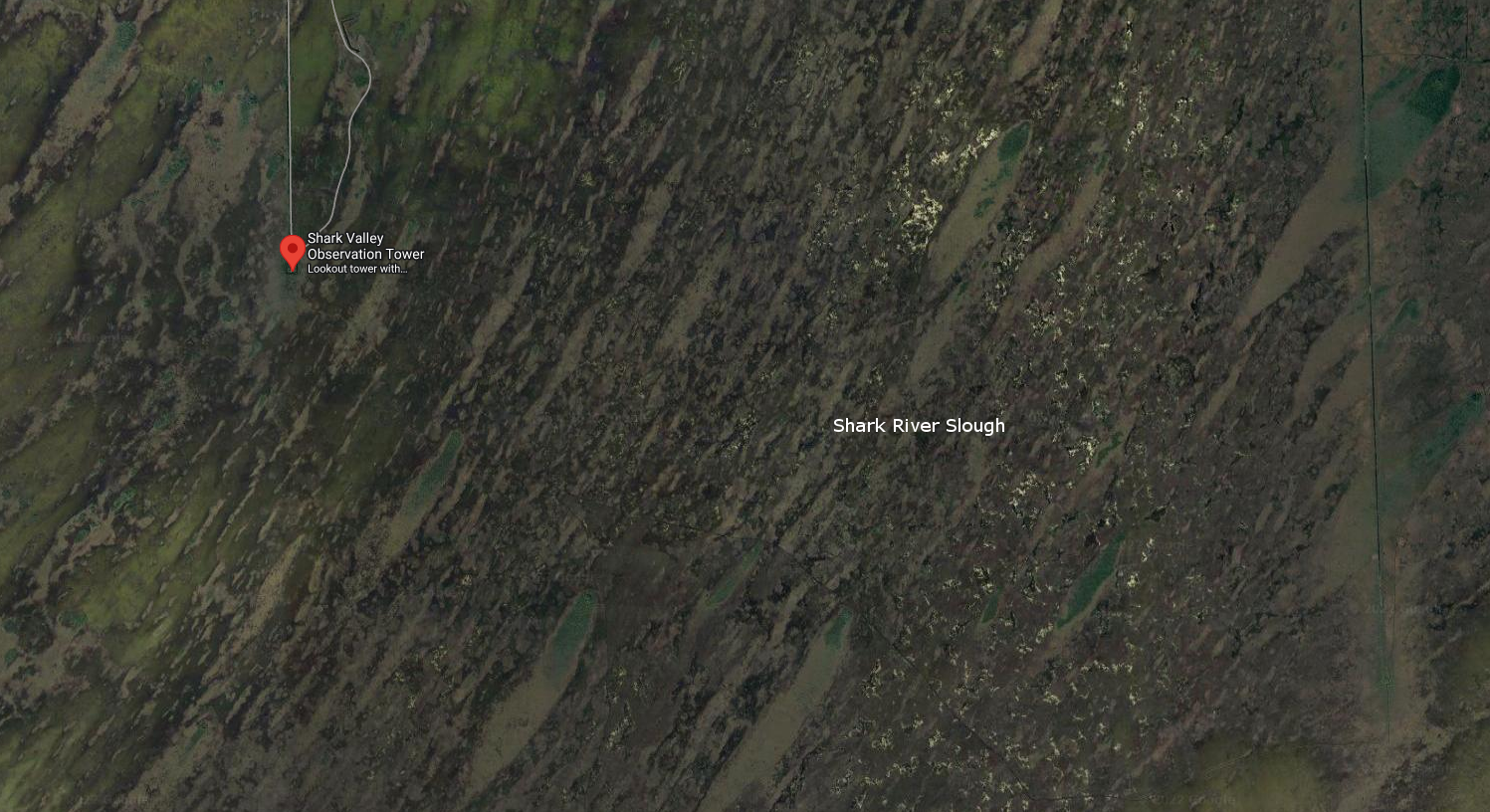
The Everglades is commonly considered a swamp. It is not. It is a broad, shallow, slowly-moving river – the “river of grass” – extending 50 miles from the southern edge of Lake Okeechobee in South Central Florida, and disappearing into Florida Bay at is southern terminus. The flow of the river, almost imperceptible, is a result of low land relief, a change of only 6 feet in the 50 miles from North to South. Yet the flow becomes readily perceptible when one looks at an aerial map of the Shark River Slough (Figure 1) with its many tear-drop shaped “tree islands”, created by the river washing the fallen and decaying plant matter to the south where it accumulates in the eddies at the southern end of the islands, extending their length.
The tree islands are of two major types. They are called “heads” if willow, bay or cypress trees predominate. They are called “hammocks” if mahogany, gumbo-limbo or other tropical hardwoods predominate. Many of the tree islands still contain “alligator holes” (Figure 2), relatively deep ponds with one or more alligator dens in them. The primary theory of the creation of the tree islands, posited by Dr. Frank Craighead (private communication), relates to the alligators changing the spot hydro-period with their behavior during the dry season.

During the semi-annual dry season, an alligator will make a depression in the peat and marl of the open Glades, which gives it a wet refuge. Females build their nests next to their refuges. The mounded detritus from these two behaviors reduces the hydroperiod (the amount of time a location is underwater) providing a base in which tree seeds can germinate and survive the flooding of the wet season. Since the avian species also depend on the water oases created by the alligators during the dry season, and since we know birds are one of the most effective spreaders of seeds, the process makes perfect sense. The deepening of the ’gator holes is posited to be due to, as biota use these reservoirs, the water in them becomes more acidic.
The underlying geology of the Everglades is from bryozoan reefs during the climactic optimum, a period when the earth was 5 degrees warmer, and the southern half of Florida was submerged under tropical seas, laying down a layer of limestone (calcium carbonate) from their remains. These are dissolved by the activity of the animal life, deepening with every season. The tree islands themselves contribute to the deepening of the ‘gator holes, as the dropping of leaves and other material is itself acidic as it decomposes. Smaller plants grow and die in the soil held by the roots of the trees, creating yet another source of organic acids to drain down into the limestone and dissolve it.
What keeps the early tree islands from decaying back into the peat underlying the fresh water open pond environment of the ‘Glades is the resident alligator each year clearing out the detritus filling his/her pond by thrashing about among the water lilies and tearing them out. I have witnessed this.
These ‘gator holes are the key to the ecology of the ‘Glades, as they act as the centers from which the repopulation of the slough occurs, as the iota spreads back across the Park when the dry season ends in June. Water levels begin dropping in October and the life of the ‘Glades concentrates in the holes. April 1965 was an exceptionally dry year and many of the holes dried up. It was a couple of years before the populations in the park fully recovered, helped by in-migration from surrounding areas (Kolipinski, Higher and Hartwell – private communication).
We studied the hydrologic conditions of the ‘gator holes at different times of the year and at different water levels. It proved not to be necessary for the holes to completely dry up before the animals surviving in them died. Low water depths affected the diurnal concentrations of the chemicals in the holes, which directly affected the ability of the animals seeking refuge in them to survive.
We concentrated on dissolved oxygen as a key indicator of the state of the holes. One alligator hole was chosen for the study. As it contained characteristics that they all had. The elevation of the willow head surrounding it was higher than that of the open ‘Glades. There is a slough draining water from the ‘Glades into its ‘gator hole from the northern end. It contains a couple of alligator dens, occupied in the winter and spring during low water levels. It was called the Cottonmouth Camp Alligator Hole, after the huge cottonmouth moccasin which would not get out of the way when first chosen for the study.
Over a 2 ½ year period (during which I participated for close to two years of it), dissolved oxygen (as well as other water chemistry measurements) diurnal readings were taken every month, conditions permitting (read: hurricanes), during both full and new moon phases. The data was collected every two hours from 11 AM one day to 11 AM the next using the micro-Winkler method for dissolved oxygen. When I first went out there Aaron Higher, the limnologist (geology of lakes and streams), who was one our two principal researchers (the other was Milton “Murph” Kolipinski, biologist) told me that after doing a 24-hour chemistries, as we called them, getting up every two hours from our sleeping bags on the hard plywood floor, I’d feel like “2,000 Chinese soldiers had camped in your mouth” (it WAS 1967!). Years later, when the South Florida Restoration Task Force was created by Congress in 1996, my mentor Aaron Higher was brought out of retirement to chair it, having been one of the principal investigators at the beginning of understanding the Ecology of the everglades (and I was there!).
Hydrologically, there are four main condition of water exchange between the surrounding glades and the alligator hole. These hydrologic conditions determine the biological population occupying the alligator hole at any given time. They are:
- Water levels are high enough so that there is a free interchange of water between the open glades and the alligator hole. The flow of water from the glades through the gator hole is approximately (undetermined at the time we wrote this paper) acre-feet/hour. Stage heights are 6.4 to 7.0 feet above sea level.
- Water levels have dropped to where the surface of the water is in the heavy grasses growing in the willow head. The vegetation slows down the exchange of water between the glades and the gator hole to approximately 5 acre-feet/hour. Stage levels are approximately 5.8 to 6.4 feet above sea level.
- The water has now dropped below the willow head, and water no longer flows from the gator hole to the glades. However the glades are still draining into the gator hole by way of the slough at the northern end. Stage levels are 5.6 to 5.8 feet above sea level.
- The water in the hole is now completely stagnant, except for ground-water flow of about 1 acre-foot per day. The hole is completely cut off from the surrounding glades, which are themselves going dry. Stage levels are 5.6 feet above sea level and lower.
Associated with each of these hydrological conditions is a biological condition. These are:
- Populations in the alligator holes are sparse (except when the gator comes home to check his mail or for a change of clothes -private joke – see African Queen post 😊)
- As we reach the lower water levels of this stage, the animals begin to concentrate in the alligator hole, their refuge, oasis and salvation.
- The animals entrapped in the open pond areas out in the glades will begin to die as the water levels drop. The alligator hole is now isolated and is teeming with fish, especially gar and catfish. The concentrated fishes, such as the bass and bream, die out as we near the lower levels of this stage. However, until then, they are a tremendously concentrated source of calories contributing to the ability of the aquatic birds to successfully breed with such an easy food supply saving them the energy needed to make babies!
- Because of the high concentration of oxygen consumers, only those fish small enough to breathe near the surface, or those fish with alveolar tissue, can survive. Gar and catfish can be seen gulping near the surface. Occasionally, at extremely low water levels, a phenomenon known as a plankton bloom occurs. Nesting and feeding birds have contributed with their excretions to the concentration of nitrates and phosphates in the water. The tremendous increase in nutrients allows the population of the plankton to explode.
Our research focused on the dissolved oxygen levels at each of the stages and its effect on the survivability of the fauna of the Everglades.