I graduated from Florida State University with an Honors BA in Anthropology. It was directly a result of Calvin Jones hiring me in the summer of 1972. An Honors degree has the same requirements of a Master’s degree or Doctorate: original research, a committee, a thesis/dissertation and a defense! I will publish my thesis in time on the Academia section of this site.
In the summer of 1972 I had 3 anthropology courses. Zooarchaeology with Stan Olsen was one. This is the identification of animal remains in archaeological sites to determine how that culture used animals for food, domestication, resources (Sorry, Vegans). Stan did not have a doctorate. During WW II he was stationed with a Harvard paleontologist who took him under his wing and mentored him. Such was his own natural ability that in time he became noted in the field. Stan was one of the most wonderful human beings I have ever had the privilege to know. I owe all this to him. Giving up his class that summer to solve my problem was one of the greatest disappointments of my academic career. He was not only a wonderful teacher, a fascinating personality with great stories of his work overseas during WW II, but also a sweet, kind, considerate man. AND in his course we worked with actual unidentified material from actual archaeological digs. We were doing real research in his class!!
The other two courses (no need to name the professors to be nice) were simply horrible. One was traditional archaeology. His lectures was as dry as the north African desert where he did his field work. The other was a straight cultural ethnology course. He was as undisciplined as he felt the “primitive” cultures were. Ethnocentric, to say the least! If I said what eventually led to his downfall it could identify him. Let’s just say it was a large shipment of contraband that he was caught with.
I went to Stan and told him my problem. By then I was known to the professors as the star student in the department. Eventually I was their first graduate who went on to doctoral studies. Stan had no problem then telling me he agreed with me about his colleagues. He told me Calvin Jones, the Florida State Archaeologist, was about to begin a major project and could use another team member. He picked up the phone, called Calvin and I was hired. I withdrew from my courses that summer.
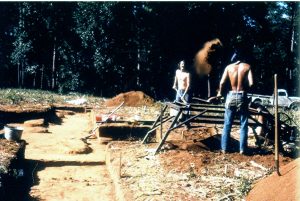
Something funny, no, not really, happened my first day as an archaeologist in the field. There is something called Salvage Archaeology. Many states have laws that if, for example, a road building project uncovers something that looks like historical remains, they must call the State Archaeologist. Interstate 10 was being built at that time. Calvin got the call. So there we are completely out in the open. No tree cover. It had all been bulldozed away. The Gulf Coast of America has the second highest rainfall in the country, next to Washington’s Olympia National Park. I like to say that we have 98% humidity with 98-degree temperatures. That is fact. By now you may have seen pictures of me back then on this site. Jewish afro and beard. People would ask if I was Jerry Garcia. I was 5”10” and 155 pounds. I would point to my lack of a belly in answer. It was so miserably hot that day I went home and took a scissor to my hair. It had been 6 years since my ears had seen sunlight. The next day they literally had second degree burns from the sun. For decades I worried about getting a skin cancer on my ears. My recollection is sunscreen was NOT well known back then!
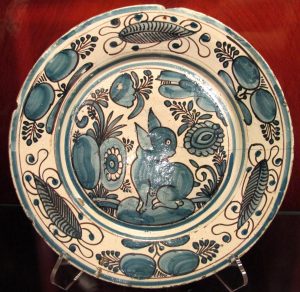
Calvin had discovered the sites of several Franciscan missions stretching from Saint Augustine to Mobile Alabama across North Florida. Years before Mission San Luis had been uncovered in Tallahassee while scaping away the ground for a golf course. It is preserved as a state park. From the archives in Spain he knew that a troop of Spanish soldiers, who regularly made a circuit of the missions in the 1700s, could make seven leagues a day across the relatively open pinelands of North Florida. So using a compass he drew a series of arcs across the map from those three locations. Then when planting season occurred, having access as the state archaeologist, he drove up and down the newly plowed rows looking for artifacts of a very colorful glazed pottery of the time. Majolica. It worked.
The plan was to find and restore a Spanish mission for the bicentennial. Then the oil crisis occurred in 1973 and 1974. The funding dried up. Everything we uncovered was buried again, but not before we had gained tremendous knowledge of what the missions were really like. Historical note: The network of missions was virtually destroyed by Carolina Governor James Moore’s incursions into northern Florida between 1702 and 1709, a series of attacks that were later called the Apalachee massacre.
To me the coolest thing, other than the silver cross I discovered in the graveyard, were the remains of the wooden poles the missions were built on. They were apparently very simple structures. The British burned them to the ground. As we uncovered the missions, we found the burned tops of the poles. As we dug down around them the poles below the burned tops were perfectly preserved, as if planted yesterday. The carbon cap acted as a filter system protecting the wood underneath it. And the relatively impervious red clay of south Georgia kept the poles dry!
So how did all this lead to my doing an Honors degree? Very curiously! One mission was called San Jose d’Ocuya, on the border of Jefferson and Madison counties. Madison was a town of 3,000 people, and 13,000 in the county, 60 miles east of Tallahassee. It was already settled when Andrew Jackson was the governor of Florida, sent to ethnically cleanse the Southeast of the Creek and Cherokee people to give their land to Whites, sending them on the Trail of Tears.
Calvin is told by the Secretary of State, his boss, that we are going to give tours of the dig. It was during guiding people around the excavation to two gentlemen of different generations, one old enough to be my father, the other my grandfather. It became clear that they each represented a different community in a town of only 3,000 people with practically no overlap in their lives! It piqued my budding anthropological, sociological, intellectual curiosity how that could be.
There were two local weekly newspapers, one associated with each of the communities within a community. There were two historical societies, likewise. In Anthropology the key research technique is to develop what we call informants within a society who tell you about their culture. My intuition told me that whatever study I conducted, this would be a place with no dearth of informants! I had no idea how right I was!
Remember, I came to Anthropology from having been an ecologist. There was already a discipline right up my alley: Cultural Ecology. In the same way Ethology studies the animal kingdom’s behavior in its natural environment, Cultural Ecology studied humanity’s interactions with its natural environment. In the West, this was primarily through agriculture. I came up with the idea of going back to the 1820’s in government archives to see how agriculture in this county had changed over 150 years. Another advantage in Florida is the Government in the Sunshine Law; ALL government records and meetings are public and must be held in public.
And there I was living in Tallahassee where all the records were kept! I quickly discovered that because modern agricultural practices, such as crop rotation and soil conservation, were unknown in 1820, there was continuous change in the crops the Madison county farmers had to raise. Man affects environment; environment turns right around and says, “Really!?” By that time I was already engaged in correspondence with the man who was to become my most important academic mentor, Lewis Mumford, who in 1956 had been one of the chairs of the international academic conference in Chicago entitled, “Man’s Role in Changing the Face of the Earth”. I already had the perfect intellectual framework to put this in. And Madison County proved to be what we call a perfect Natural Experiment. And that was my Thesis!
You can find the PDF in the Archaeology section of the Appendices or by clicking here.